
There are two halves of the building product manufacturer marketing coin: distributing technical content and producing it.
Many agencies are excellent at the distribution half: getting your content in front of the architects, engineers, and specifiers who decide whether your product gets written into a project. Websites, campaigns, paid media, social, email, and analytics. The activation layer. Getting your message to specifiers is non-negotiable, and this isn't an argument against it.
But there's a catch. Distribution amplifies whatever you feed it. The amplification process assumes your technical content is already sound. If the content you hand it is flimsy, distribution just helps more people notice that it's flimsy.
That second half — the deep, technical production — is drastically underserved. And it's the one the specifier actually needs.
Here's the uncomfortable question most manufacturers never ask before they spend on distribution: how do you know the technical content itself is any good?
What happens when your positioning doesn't survive the first hard question from an engineer? When your CEU doesn't pass muster with the AIA? When your specification language never gets picked up by the specifiers you wrote it for, or by the LLMs that increasingly surface product information to them?
Ensuring the technical content is right is a different discipline from distributing it. And if that discipline is in your agency contract at all, it's usually the thinnest slice of the pie.
What does "going deep" even mean?
"Deep" is easy to claim and hard to define, so let's get specific.
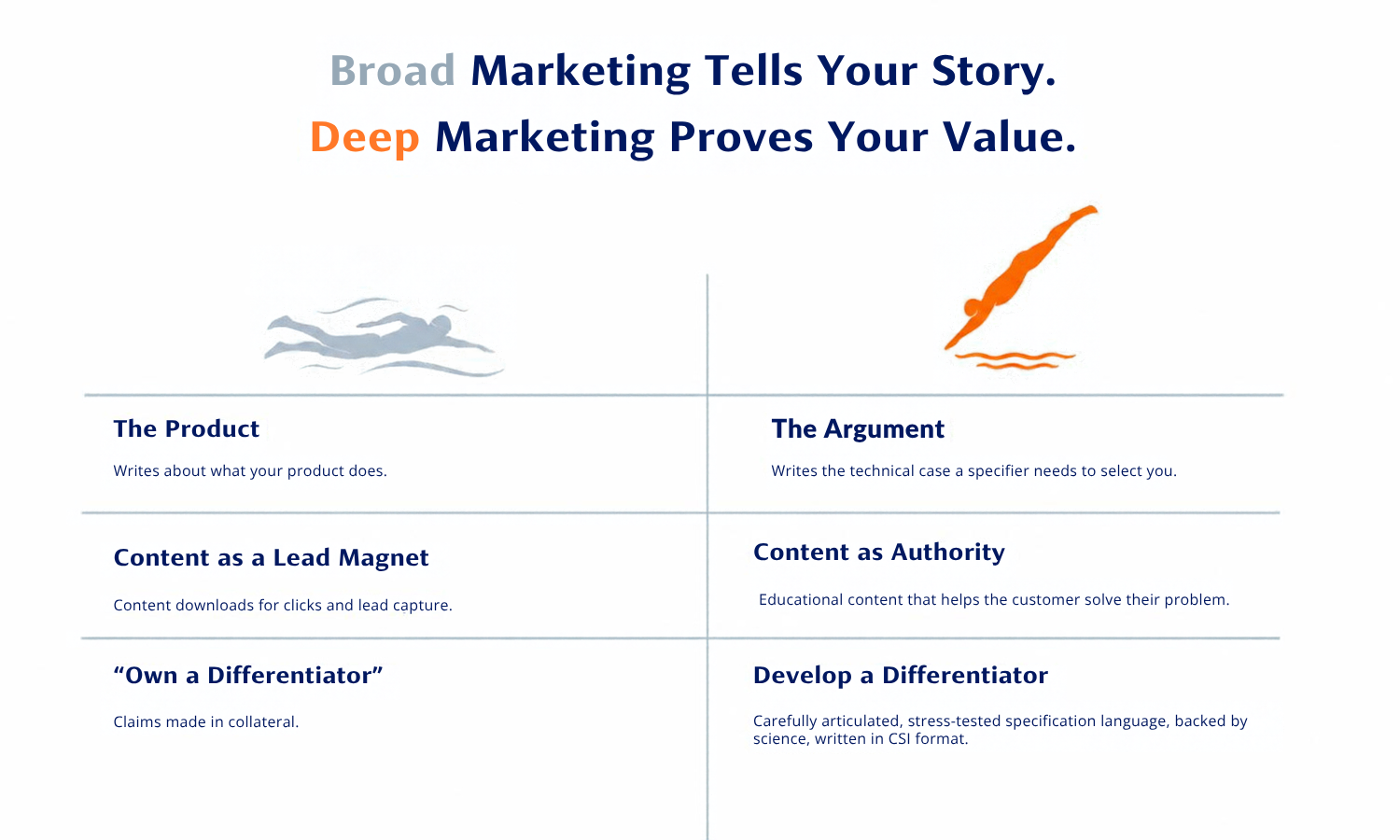
Broad marketing writes about what your product does. Deep marketing writes the technical argument a specifier needs to choose your product and defend that choice to the rest of the project team.
Deep marketing doesn’t treat a CEU like any other lead-generation asset. A CEU with depth is genuinely educational, survives accreditation, and establishes your brand as a thought leader on the problem your product solves, so architects come to you as a resource, not a vendor.
Spec sheets aren't just another download. Good guide specs are written to format, with your differentiators built in so that a specifier can lift the language straight into their construction documents.
And "own a differentiator" isn't a slogan. It's the work of auditing and stress-testing until you've proven a differentiator defensible enough to survive value engineering, backed by science.
Deep spec-channel marketing earns you fluency in the specifier's technical world, not just the marketer's. It's the difference between content about the product and content that does the work to solve the specifier’s problem.
What deep looks like when it's done right.
I was once working through a performance positioning exercise with a manufacturer. Their product had a strong performance story around one environmental threat, the kind of claim you'd build a whole campaign on: solid data, unique differentiation, a clear reason for a specifier to choose it.
A broad approach would have run blind with it: build the campaign, produce the collateral, push it out. The claim was true, after all.
But we pushed on the claim because a claim you haven't stress-tested is a claim you don't fully understand yet; we found an alarming paradox. The claim was tied to a regional climate. In those same regions, a second regional climate performance requirement mattered just as much. On requirement A, the product was gold. On requirement B, it was a liability. The strength and the weakness lived in the same regions.
Nobody in the room had connected those two facts before. Not because they weren't smart, but because nobody had asked the two questions back-to-back. A broad, amplify-the-claim approach never would have surfaced it. The first time that conflict would have come up was in a live sales call, with a specifier in exactly that region asking how the product handled both conditions at once, and a rep discovering the problem in real time.
That's the difference deep technical rigor gives you. The deep technical dive found the landmine in a working session. The broad approach would have amplified the campaign right up until a specifier found it for us.
The cost of skimping on the deep half.
When the technical work is thin, the failures are specific and expensive: the erosion of trust. A CEU that's really a sales pitch in disguise doesn't get re-booked, and architects quietly stop accepting the invitation. A spec written without a defensible hook gets value-engineered out the moment a cheaper alternative appears, because nothing in the language holds your position.
Erosion of trust doesn’t show up on a marketing dashboard. You’ll still see impressions meeting target and a robust-looking pipeline, for a little while at least. You lose trust one specification at a time. By the time erosion hits revenue, the trail back to the thin content is cold.
How to spot your technical gap.
You don't need an outside opinion to diagnose this. Just ask your own team:
Can anyone here write guide-spec language to format, with your differentiators built in?
Has your most recent CEU been re-booked by the firms that attended it, or did it run once and quietly disappear?
If an engineer challenged your lead performance claim tomorrow, is there documented science behind it, or does it rest on a spec sheet and a hope?
Do you know your specification position on your top projects, or is it a gut feel living in a rep's head?
If more than one of those made you pause, the gap isn't in how you're distributing your content. It's in the depth of the content itself.
Closing the gap starts with positioning.
The good news: this is fixable, and it doesn't start with producing more content. It starts with the foundation, because everything downstream — the CEU, the guide-spec language, the campaign — is only as strong as the positioning underneath it.
CCM's Positioning Workshop helps manufacturers solve the foundation problem. Before we translate anything into specifier-facing benefits, we help you get the positioning right. Give us a day, and we’ll run the stress test you just read about. We’ll guide your team through pressure-testing your product against the competitive field, evaluate your differentiators, and make those differentiators defensible enough to survive value engineering. The result is a technical positioning strategy backed by the science, so the specifier nods instead of pushing back.
Sound positioning gives your technical content a leg to stand on. The next step is translating that validated positioning into the clear, practical benefits a specifier can act on, through our Benefit Translation work. Get the technical positioning right, and everything you hand to the activation layer is finally worth amplifying.
Being seen is one thing. Being specified is another. Being seen is a distribution problem, and it's largely solved. Being specified is a depth problem, and it's where projects are won or lost.
If you're not sure whether your product positioning would survive a specifier's scrutiny, start there. Book a free 30-minute call, and we'll figure out whether your spec-channel foundation is solid, where it's thin, and where to begin.